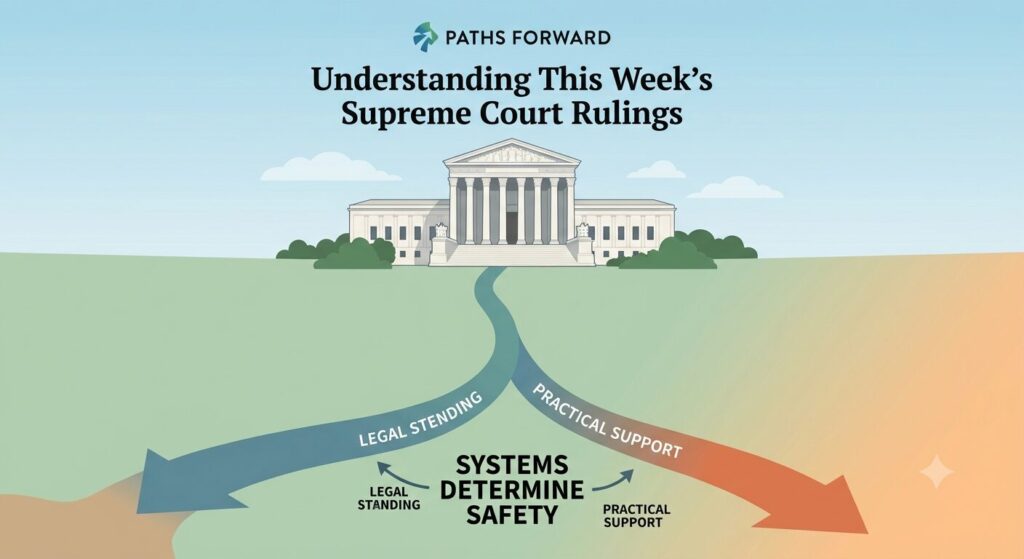
The landscape of humanitarian pathways in the United States shifted profoundly today following two major Supreme Court rulings. In separate 6-3 decisions, the Court reshaped border asylum processing. It also altered legal protections for hundreds of thousands of long-term residents. At The Asylum Project, we believe that individual safety and family stability depend directly on these systems.
At The Asylum Project, we believe safety and family stability depend on complex rules. These systems determine who can stay, work, and access healthcare. When these large-scale systems change overnight, the downstream effects create immediate crises for families and individuals.
To help our community of donors, partners, and families navigate these complex developments, we have broken down what these rulings change in plain English, what they do not change, and how we can collectively respond.
1. Supreme Court Rulings on Border Asylum and “Metering”
In a 6-3 decision, the Supreme Court ruled that federal law allows the U.S. government to physically stop asylum seekers from entering the country. Consequently, this effectively blocks them from initiating an asylum application at the southern border.
- What Changed: As reported by Reuters, the ruling validates the practice of “metering.” This means border officials have the legal authority to refuse entry. They can pause processing entirely when ports of entry are overburdened.
- The Practical Impact: For individuals arriving at the border, the policy changes whether they can even begin the legal asylum process. It introduces massive uncertainty. Officials can now turn processing access on or off based on administrative capacity.
- What This Does Not Mean: This ruling does not completely abolish the right to asylum under every circumstance, nor does it mean all border crossings or legal pathways have vanished. Access has become highly variable and logistically restricted, making case-by-case evaluation more critical than ever.
2. Supreme Court Rulings End TPS for Haitians and Syrians
In a concurrent 6-3 ruling, the Supreme Court cleared the way for the administration to terminate Temporary Protected Status (TPS) for nationals from Haiti and Syria.
- What Changed: According to reporting from NPR, the Department of Homeland Security (DHS) can now swiftly wind down legal protections that have shielded these communities for years. Specifically, the Associated Press notes that this decision directly impacts approximately 350,000 Haitians and 6,000 Syrians.
- The Practical Impact: TPS is fundamentally a family stability issue. Hundreds of thousands of people have built lives, purchased homes, and raised families in the U.S. Now, they face immediate deportation risks and the sudden loss of work authorization. the U.S. face the sudden loss of work authorization and driver’s licenses, alongside immediate deportation risks.
- Next Steps for Impacted Individuals: If these TPS changes affect you, please review your paperwork and timeline options. It is vital to seek individualized advice from qualified legal aid organizations.
The Broader Context: “Invisible” Administrative Barriers
While Supreme Court headlines command public attention, everyday stability is frequently eroded by quieter, administrative shifts. In addition, secondary barriers are tightening across the country:
Why Philanthropy Must Pivot to Preventative Support
For our supporters and donors, these twin Supreme Court rulings underscore a critical reality. Ultimately, preventing a crisis costs significantly less than responding after it occurs. When the government revokes work authorizations or drops health coverage, families can quickly fall into a spiral of job loss and eviction. Donors often underestimate how easily a missed administrative notice can uproot a household.
Philanthropy can provide the legal and logistical footholds families need to navigate unpredictable systems. Therefore, we must invest heavily in legal defense funds, documentation hygiene, and proactive safety planning. Organizations like the ACLU and NILC remain on the front lines. They translate complex enforcement policy into practical, localized support.
Resources & Community Guidance
If you or your community are navigating these policy changes, remember to rely on verified information and professional legal support. Avoid navigating these shifts based on rumors or broad generalizations.
- Know Your Rights & Safety Info: USAHello offers comprehensive, practical safety resources tailored for immigrant communities.
- Medicaid and Healthcare Updates: To track ongoing changes to healthcare access and avoid coverage gaps, consult the KFF Medicaid Topic Hub.
- Legal Guidance: Consult a licensed immigration attorney or an accredited representative to explore individualized legal pathways or alternative reliefs that may apply to your specific situation.
Stay up to date on other court rulings and legislation by signing up for The Asylum Project’s resources newsletter, Crossing Points.