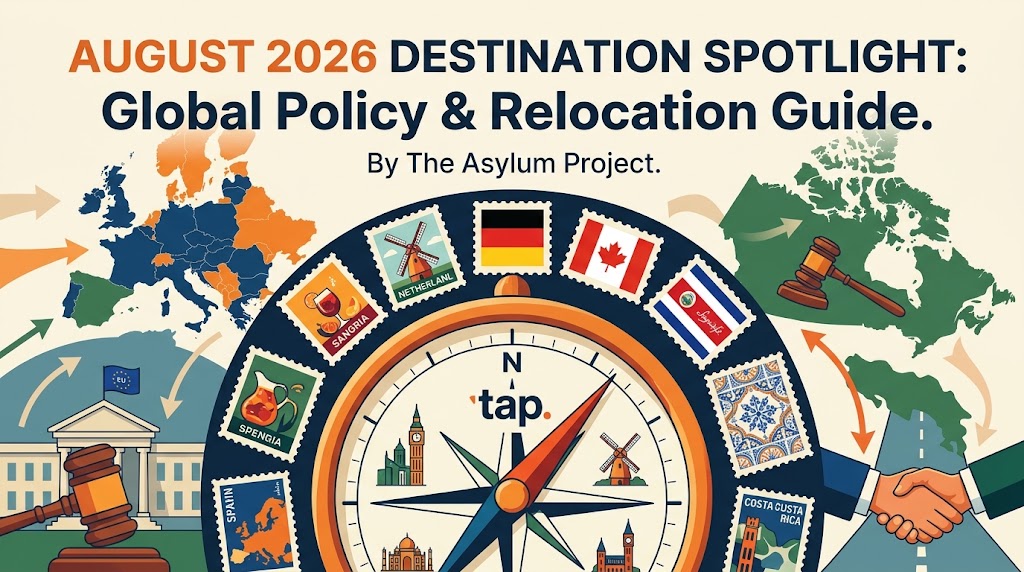
Relocating to find a safer, more inclusive home is a powerful and deeply personal choice. As global policies shift, understanding your international relocation pathways 2026 options is essential for navigating asylum rules, visa requirements, legal protections, and housing markets worldwide.ing refuge is completely valid.
However, we need to have an honest, peer-to-peer conversation. The dream of “just moving” or finding an easy asylum pathway is increasingly complex. For those looking to relocate internationally in 2026, standard immigration visas (like skilled worker, passive income, or digital nomad programs) remain a far more viable and legally secure route for Americans than traditional asylum claims.
Here is our honest breakdown of key global destinations for August 2026, weighing their progressive legal profiles against housing market realities and immigration hurdles.
What to Know About International Relocation Pathways 2026
Before diving into individual countries, it is critical to understand major policy and structural shifts that govern international relocation this month:
- Asylum Access Is Tightening Globally: Canada’s Bill C-12 (enacted March 2026) bars asylum claims filed more than one year after your first entry into Canada and enforces a 14-day filing rule for irregular land-border crossings under the Safe Third Country Agreement. Across Europe, the EU Migration Pact (effective June 12, 2026) has standardized temporary 3-year asylum permits, eliminated new permanent asylum grants, and paused certain family reunification decisions.
- The EU Housing Market Shock: According to Eurostat’s Q1 2026 Housing Release, housing prices across the EU rose 5.1% year-over-year while rents increased 3.0%. Portugal led the entire EU with a massive 17.8% annual house-price increase, proving that low-cost reputations must be re-evaluated.
- Formal Law vs. Daily Safety: High national equality rankings do not eliminate daily social friction. Across all focus countries, BIPOC clients should know that formal anti-discrimination law does not erase racism in housing, employment, or healthcare. Neighborhood-level planning is essential.
The Takeaway: Relocation and asylum must be screened as separate legal strategies. Successful asylum claims generally require an individualized showing of persecution, inadequate state protection, and proof that internal relocation is unreasonable. Pursuing visa-based immigration pathways is TAP’s recommended strategy for most clients.
Comparing International Relocation Pathways 2026
| Destination | Primary Visa Route for U.S. Citizens | LGBTQ+ Legal Profile | Healthcare & Trans Access | Housing & Market Reality |
| Spain (Top Pick) | Digital Nomad OR Non-Lucrative Visa | #1 in Europe (89%) on ILGA Rainbow Map 2026 | Public care depathologized; regional wait times vary | High rent pressure in Madrid/Barcelona; 10.5% national unemployment |
| Germany | EU Blue Card or Opportunity Card | Solid (70%); strong legal protections & trans rights | Broad public insurance base; requires prep for care waiting lists | Competitive market; 53% live as tenants; high pressure in tier-1 cities |
| Canada | Express Entry / Provincial Nominee | Strong constitutional & federal protections | Publicly funded; provincial access varies widely | Asking rents easing per CMHC Mid-Year Update; Toronto/Vancouver costly |
| Netherlands | DAFT (Self-Employed) Visa | Protective (64%); strong institutions | Core insurance required; acute gender-clinic wait times | Severe housing crisis; municipal registration strictly required |
| Portugal | D7 (Passive Income) or Digital Nomad | Progressive (67%); monitoring proposed trans law changes | SNS public health enrollment or private coverage | Highest EU house-price rise (+17.8%); no longer a broad budget option |
| Costa Rica | Digital Nomad Visa ($3k/mo income floor) | Established marriage equality & identity protections | Public CCSS limited; UNHCR agreement covers 600 urgent cases | Expat hubs expensive; 7.3% projected unemployment |
Deep-Dive Destination Profiles

1. Spain (Our Strongest Legal & Policy Pick)
Spain offers one of the most accessible international relocation pathways 2026 for digital nomads and passive income earners.
- Immigration Pathways: The Living in Spain Migration Portal outlines clear pathways. Remote workers can utilize the Digital Nomad route (indexed to minimum wage, requiring ~$3,000+/month), while non-working individuals with savings can leverage the Non-Lucrative Visa.
- LGBTQ+ Climate: Ranked #1 among 49 European countries on the ILGA-Europe Rainbow Map 2026 with an 89% score. Spain has implemented trans equality plans, established an independent equal-treatment authority, and fully depathologized trans identity in healthcare.
- Healthcare & Trans Care: Depathologization creates a strong national policy signal. However, care delivery is managed regionally by autonomous communities—clients must confirm local prescription bridging and specialist waiting times before travel.
- Housing & Job Realities: Housing pressure remains acute in Madrid, Barcelona, and coastal hubs. Eurostat reports a 10.5% national unemployment rate for late 2025/2026, meaning clients dependent on local employment need a longer financial runway than remote income earners.

2. Germany (Leading Employment Pathway)
For skilled workers, Germany provides structured international relocation pathways 2026 through the EU Blue Card and Opportunity Card.
- Immigration Pathways: The EU Blue Card Guidance sets clear salary thresholds for 2026 (€50,700 standard, €45,934.20 for shortage occupations/graduates). The Opportunity Card offers points-based entry for job seekers with proof of ~€1,091/month in net funding.
- LGBTQ+ Climate: Scores 70% on the Rainbow Map with comprehensive self-determination laws and strong anti-discrimination protections.
- Healthcare & Infrastructure: Mandatory health insurance provides exceptional baseline coverage. In practice, gender-affirming care can involve specialist documentation and regional wait periods.
- The Big Caveats: Eurostat data shows 53% of Germany lives in rented housing. Major hubs like Berlin, Munich, and Hamburg face intense rental competition. High German-language reliance in medical and job settings remains a barrier for newcomers.

3. Canada (Evaluate on a Regional Basis)
Canada remains a viable destination, but national generalizations no longer apply—you must evaluate options province by province.
- Immigration Pathways: Express Entry and Provincial Nominee Programs continue to reward skilled applicants.
- Asylum Reality Check: Bill C-12 renders claims filed more than 1 year after first entry ineligible for referral. Irregular land-border entrants face a 14-day rule. Consult qualified legal counsel before making travel decisions.
- Healthcare Access: Women and Gender Equality Canada reporting highlights that healthcare access and gender-affirming care coverage vary significantly across provinces, with some regions experiencing political pushback.
- Housing Reality: The CMHC Mid-Year Rental Update shows asking rents easing in major markets as supply increases, though Toronto and Vancouver remain high-cost environments requiring Canadian income/credit verification.

4. The Netherlands (Strong Protections, Acute Capacity Constraints)
The Netherlands offers world-class legal protections, but severe housing shortages mean advanced planning is essential.
- Immigration Pathways: Self-employed Americans can take advantage of the Dutch-American Friendship Treaty (DAFT) route via the IND Portal.
- New EU Migration Rules: Under the IND June 2026 Migration Pact Update, standard asylum permits are valid for 3 years, permanent asylum permits are no longer newly issued, and select family reunification decisions face temporary pauses.
- Healthcare & Trans Care: While core health insurance is mandatory, gender-clinic waiting lists are severe. Clients must not assume rapid transfer into specialist care without prior local arrangements.
- The Housing Bottleneck: Housing supply is a threshold barrier. You should never arrive in the Netherlands without securing housing that legally permits municipal registration (inschrijving).

5. Portugal (Conditional Recommendation)
Portugal remains a viable option for remote earners, but it should no longer be framed as an default low-cost refuge.
- Immigration Pathways: The D7 Passive Income and Digital Nomad visas remain accessible, supported by AIMA’s ongoing legacy file processing. Residence documentation requires proof of income, housing, and health coverage (via SNS enrollment or private insurance per the AIMA FAQ).
- Legal Watchpoint: Scores 67% on the 2026 Rainbow Map, but TAP is monitoring draft legislation reported by ILGA-Europe that could impact legal gender recognition self-determination and intersex protections.
- Housing Reality: According to Eurostat’s Q1 2026 Release, Portugal recorded a 17.8% year-over-year house price surge—the highest in the EU. Lisbon, Porto, and the Algarve require substantial budgets.

6. Costa Rica (Best for Independent Remote Earners)
Costa Rica provides a stable, picturesque environment for remote workers, though healthcare and refugee infrastructure are concentrated.
- Immigration Pathways: The Official Digital Nomad Portal provides a 1-year renewable permit for remote workers earning at least $3,000/month ($4,000/month with dependents).
- LGBTQ+ Protections: Same-sex marriage and legal identity updates are established law. However, specialized gender-affirming care is largely concentrated in the San José Central Valley.
- Healthcare Realities: Public CCSS coverage is constrained; a limited UNHCR-CCSS 2026 Agreement covers only 600 forcibly displaced individuals with urgent needs. Private insurance is essential for newcomers.
- Economic Landscape: High local unemployment (7.3% projected by the OECD) means newcomers should rely on remote income rather than local employment.
Finding Your Path Forward
Relocating is a journey of compromises. While Spain offers robust protections and Canada maintains high legal standards, asylum rules are tightening globally. Meanwhile, options like Portugal offer an inviting lifestyle, but housing costs and public medical capacity require careful planning.
If you are preparing to make the leap, focus on formal, visa-based immigration pathways rather than relying on the tightening safety net of international asylum. Do your research, plan your finances, and step forward with clear eyes.
Pack Your Plans with Facts, Not Just Hope
Navigating international laws, income minimums, and changing visa policies can feel overwhelmingly complex—especially when searching for a stable, safe destination.
To help you sort through the noise, we have published the August 2026 Destination Spotlight Fact Sheet. This free, high-density PDF resource is designed to serve as your quick-reference anchor.
Inside the downloadable guide, you will find:
- The 2026 Policy Reality Check: A detailed breakdown of major legal shifts, including Canada’s Bill C-12 restrictions and the EU’s newly effective unified Pact on Migration & Asylum.
- The August Spotlight Matrix: A side-by-side comparison comparing key global destinations on visa criteria, LGBTQ+ index rankings, and health infrastructure.
- Detailed Financial & Medical Thresholds: Concrete numbers on digital nomad minimums (e.g., Spain’s ~$3,000/mo income floor), Blue Card salary rules, and public vs. private insurance requirements.
- Primary Immigration Portals: Direct access to official entry tracks including Canada IRCC, Dutch IND, Portuguese Vistos, Spanish Exteriores, and Make It In Germany.
- Civil Rights Tracking: Verified paths to cross-reference legal metrics via global tracking databases like Equaldex and ILGA World.
- Healthcare Resources: Clear reference links to evaluate medical policy options via resources like the Expatsi Disabled Expat Guide.
Don’t guess on your future. Step forward with data and clear eyes.